
WHAT IS A REPEATER?
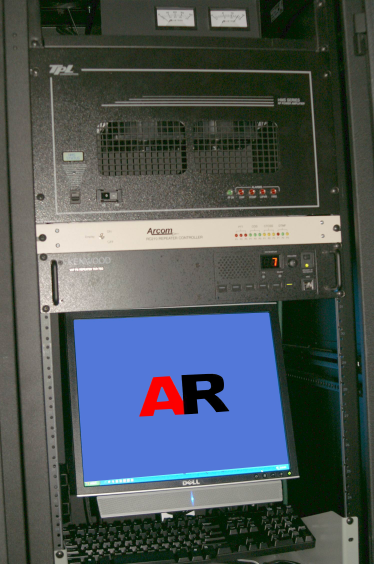 A repeater consists of a radio receiver, an amplifier, a transmitter, an isolator, and one or two antennas. The transmitter
produces a signal on a frequency that differs from the received signal. This so-called frequency offset is necessary
to prevent the strong transmitted signal from disabling the receiver. The isolator provides additional protection.
A repeater, when located on top of a high building or tower, can greatly enhance the performance of low power
walkie-talkie and mobile Amateur Radio equipment by allowing communications over distances much greater than would
be possible without it.
A repeater consists of a radio receiver, an amplifier, a transmitter, an isolator, and one or two antennas. The transmitter
produces a signal on a frequency that differs from the received signal. This so-called frequency offset is necessary
to prevent the strong transmitted signal from disabling the receiver. The isolator provides additional protection.
A repeater, when located on top of a high building or tower, can greatly enhance the performance of low power
walkie-talkie and mobile Amateur Radio equipment by allowing communications over distances much greater than would
be possible without it.
The main W4AVA repeater consists of a radio receiver, amplifier, transmitter, isolator, and a single antenna. The repeater
receives incoming signals on 146.025 MHz (or satellite receivers located in the National Capital Region) and retransmits
signals on 146.625 MHz. Duplexers allow the same antenna to be used for simultaneously for received and transmitted
signals.
The repeater system also includes a controller, a computer that transmits the FCC-required station identification in
voice and "W4AVA/R" in Morse Code. The "R" transmitted in Morse Code after call sign W4AVA indicates that the station is
a repeater. The controller also is programmed to require any incoming signal to include a subaudible tone at 107.2 Hertz
in order to activate the repeat function and retransmit the incoming signal on 146.625 MHz. The purpose of the subaudible
tone is to minimize interference from distant stations or operators transmitting on the repeater's input frequency.
A voting device is used at the main repeater site to select from among the strongest signals received via the repeater's
remote receivers. The W4AVA repeater system presently includes five remote receivers located in Virginia and Maryland.